Varsha’s Story: Curiosity, Commitment, and the Science Behind FOXG1

Varsha at Letchworth State Park in Summer 2025.
Varsha’s path to FOXG1 research began with curiosity. The kind that starts small, grows quietly, and eventually becomes impossible to ignore.
Originally from Bengaluru, India, Varsha Ramachandra Kambar grew up fascinated by how things work at the most fundamental level. That curiosity led her to study Biotechnology and Molecular Biology, where she first discovered the power of molecular science. What stood out to her was how tiny changes at the cellular level can shape entire systems, including the developing brain. Once that door opened, she knew research was where she belonged.
Today, Varsha is a second-year PhD student at the FOXG1 Research Center, studying how the FOXG1 gene is regulated and what controls its expression during brain development. Her work sits at the intersection of deep scientific curiosity and a very real hope: contributing knowledge that could one day help children and families affected by FOXG1 syndrome.
Finding Her Way to FOXG1
Varsha chose to pursue her PhD at the University at Buffalo because of its strength in biological sciences and its focus on tackling complex problems using cutting-edge tools. When she first encountered the FOXG1 gene, it immediately stood out to her.
FOXG1 is a challenging gene to study, its regulation is tightly controlled, and its sequence includes repeat-rich regions that complicate both experimental design and analysis. For Varsha, that complexity was not discouraging. It was exciting.
Seeing the progress already underway in the Lee lab, particularly the work toward gene therapy approaches for FOXG1 syndrome, made the decision feel right. It was a place where she could learn, contribute meaningfully, and grow as a scientist while working on a gene that still holds many unanswered questions.
Life in the Lab
No two days in Varsha’s lab work look exactly the same. Her mornings often begin by checking on cells or preparing samples for experiments. From there, her time is spent running molecular biology and neuroscience assays, analyzing data, troubleshooting unexpected results, and planning what comes next.
There is also a lot of reading, discussion with lab mates, and careful thinking. Research rarely follows a straight line, and Varsha embraces that reality. Failed experiments are not wasted time. They are lessons that shape better questions and stronger approaches.
One of the biggest adjustments for her was working with animal models. Coming from a molecular biology background, moving into neuroscience and mouse work felt overwhelming at first. It was unfamiliar and, at times, intimidating. But with support from the lab and persistence, she worked through that discomfort and gained confidence in an entirely new area of research.
That willingness to step into the unknown defines much of Varsha’s journey.
The Questions That Keep Her Curious
What excites Varsha most about FOXG1 research is how one gene can influence so many steps of brain development. FOXG1 is active throughout life, yet so much about how it functions remains unknown.
She is particularly interested in how FOXG1 expression is regulated. When does the gene turn on or off? What factors control it? Which partner proteins does it interact with? Her work focuses on special DNA sequences called enhancers that fine-tune when and where FOXG1 is expressed. These are not small questions and answering them takes patience and precision.
Varsha’s current work focuses on studying FOXG1 enhancer elements and understanding how they regulate gene activity. She is using both in vitro assays and in vivo approaches, including AAV9-mediated delivery, to test how restoring FOXG1 expression might reverse brain defects seen in FOXG1 syndrome.
In simple terms, her research is working toward making gene therapy approaches more precise. FOXG1 is not expressed everywhere in the brain, yet gene therapy delivery reaches broad regions. Varsha is working to understand how to make these therapies more targeted, so FOXG1 is expressed where it is truly needed.
It is detailed, careful work, but it lays essential groundwork for future therapeutic strategies.
Why This Work Matters
For Varsha, FOXG1 research is deeply personal, even though she has not yet had the chance to meet FOXG1 families directly.
She knows that behind every dataset and experiment are children who cannot communicate easily, families navigating uncertainty, and parents hoping for progress. That awareness brings responsibility to her work.
The research happening in the lab is not abstract. It is intentional, serious, and driven by a genuine desire to deliver results. The team relies on the most advanced tools available and constantly updates their approaches to reflect the best science possible.
Varsha wants families to know that every experiment is carried out with care and purpose. Progress in science is often slow and built from many small steps, but each step matters. Even when breakthroughs are not immediate, the work continues with dedication and focus.
Moments That Define the Journey
One of Varsha’s most meaningful moments came when she finally narrowed down the area of research she wanted to focus on. Sitting down with her principal investigator to plan experiments, she felt something shift. The project became real. It became hers.
That sense of ownership fuels her motivation, especially during challenging days. When experiments do not work as planned, she finds herself thinking through troubleshooting long after leaving the lab. She is often planning the next set of experiments in her head or revisiting ideas she has not had time to explore yet.
Support from mentors like Jae and Soo has played a huge role in that process. Their thorough planning and guidance help her navigate challenges and build confidence as a developing scientist.
Beyond the Bench
Outside the lab, Varsha keeps her life active and balanced. She enjoys playing tennis, going for long runs, and working out, all of which help her clear her mind during busy weeks. She is also a huge fan of movies and TV series and loves exploring new foods, whether through cooking or discovering places with unique flavors.
One especially meaningful part of her life is classical dance. Even while living in the U.S., she continues taking online classes with her teacher in India. It is a connection to home and a source of joy that grounds her amid the demands of graduate research.
Looking Ahead
When Varsha thinks about the future of FOXG1 research, she feels hopeful. She is encouraged by the steady progress toward gene therapy approaches and the growing understanding of FOXG1 biology.
In the coming years, she expects research to focus on refining delivery methods, improving safety, and understanding how timing and expression levels influence outcomes. Each study builds toward the possibility of clinical testing, step by step.
Her hope is simple and powerful: that the science continues moving forward in ways that bring real benefit to families.
For Varsha, being part of the FOXG1 Research Center means more than earning a degree or publishing results. It means contributing to a collective effort driven by curiosity, care, and a shared commitment to children and families living with FOXG1 syndrome.
And that commitment shows up every day, quietly and faithfully, at the bench.

Varsha in Buffalo, NY during the holiday season 2025.

FOXG1 Research Center is dedicated to understanding and finding treatments for FOXG1 syndrome and other neurodevelopmental disorders.
Our Team
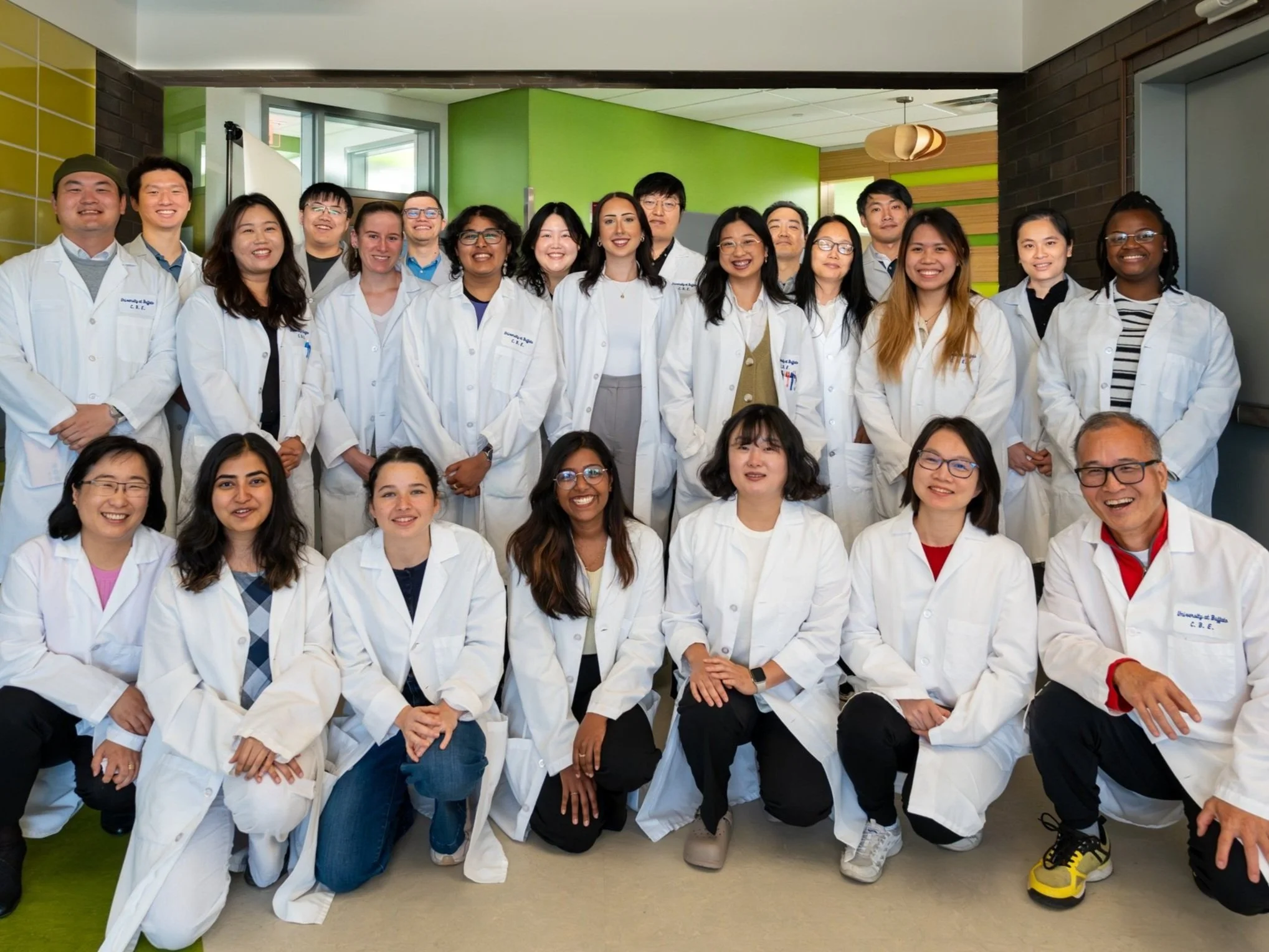
Drs. Soo-Kyung Lee, PhD. and Jae W. Lee, PhD. are the principal investigators of FOXG1 Research Center. Our team is full of dedicated individuals with the common goal of studying FOXG1 Syndrome to find treatment options and further understand the condition.

Our Publications
To learn more details about our research, please refer to our publications.